Can you help your child to make an early start with learning English, or should you leave it to their school?
The answer to this question will depend on how much English you speak, on your school system and on your long-term aims for your child. Of course, the child needs to be motivated to learn English, but if they’re taught at the right age and in the right way, they’re highly likely to be motivated.
It’s possible to teach your child a little English even if you don’t speak it yourself. Good lesson materials will help with that. But to take things farther, it’s best that you speak enough English to avoid basic grammar mistakes. A good compromise is to organise online lessons with a native speaker, and to support your child with practice between lessons.
Primary-school age is an excellent time to learn a new language. The brain is receptive and many children still find learning fun. They also have more free time than they’ll have when they start secondary school. My preferred age for a first English lesson is 7 or 8, when children can read and write in their own language and are used to working with a teacher. You can start younger if you like, by teaching vocabulary and little sentences through repetition, but don’t feel that you need to. I meet children who have spent months or even years “learning English” in small group lessons, but only know the numbers and colours. That kind of English class is a complete waste of time.
Learning one-to-one with a parent or teacher who is taking the lessons seriously is very effective. Your child will learn more quickly than they will at school. English will become their best subject, and having a subject they’re good at really helps children gain confidence. If you’re not happy with how your school system teaches English, you can make up for that with your own lessons. Children who learn English this way learn to take control of their own learning, which can extend into adult life.
Don’t feel that you have to focus on what your child is, or will be learning at school. Exams are a long way away. Starting early means that a child can simply learn English for communication. Let them have fun with it. You’ll find that what they learn informally, at home, will in fact help them in exams in the future, even though they’re not following the exam syllabus.
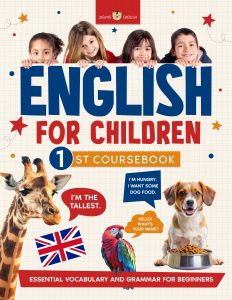
I love teaching complete beginners from the age of 7 or 8. Some Korean children who spoke no English (in fact they didn’t know the alphabet), inspired me to write my first 5 books for primary-age children. These are reading books and dialogue books, and my Korean students have finished all 5 books and are now at a more advanced level. I’ve now added a first coursebook for complete beginners. It covers the essential first grammar and vocabulary. There are other coursebooks on Amazon, so why choose this one? Well, it’s carefully written to build your child’s English from zero to a point where they can understand a surprising amount of English. And it’s designed to be creative, fun and even funny. There are hundreds of photos to help with vocabulary. There’s even an interview between a little girl and a very interesting bird. This is a serious book though, and there are 3 tests with answers, to help you make sure that your child understands what they’re learning. I hope you and your child enjoy it.
I’m always looking for new ideas for books to help children and adults learn English. Please send any ideas to me on the Zigzag English website: